
Loading...
Serving Jefferson City, MO and surrounding areas. (573) 257-2944
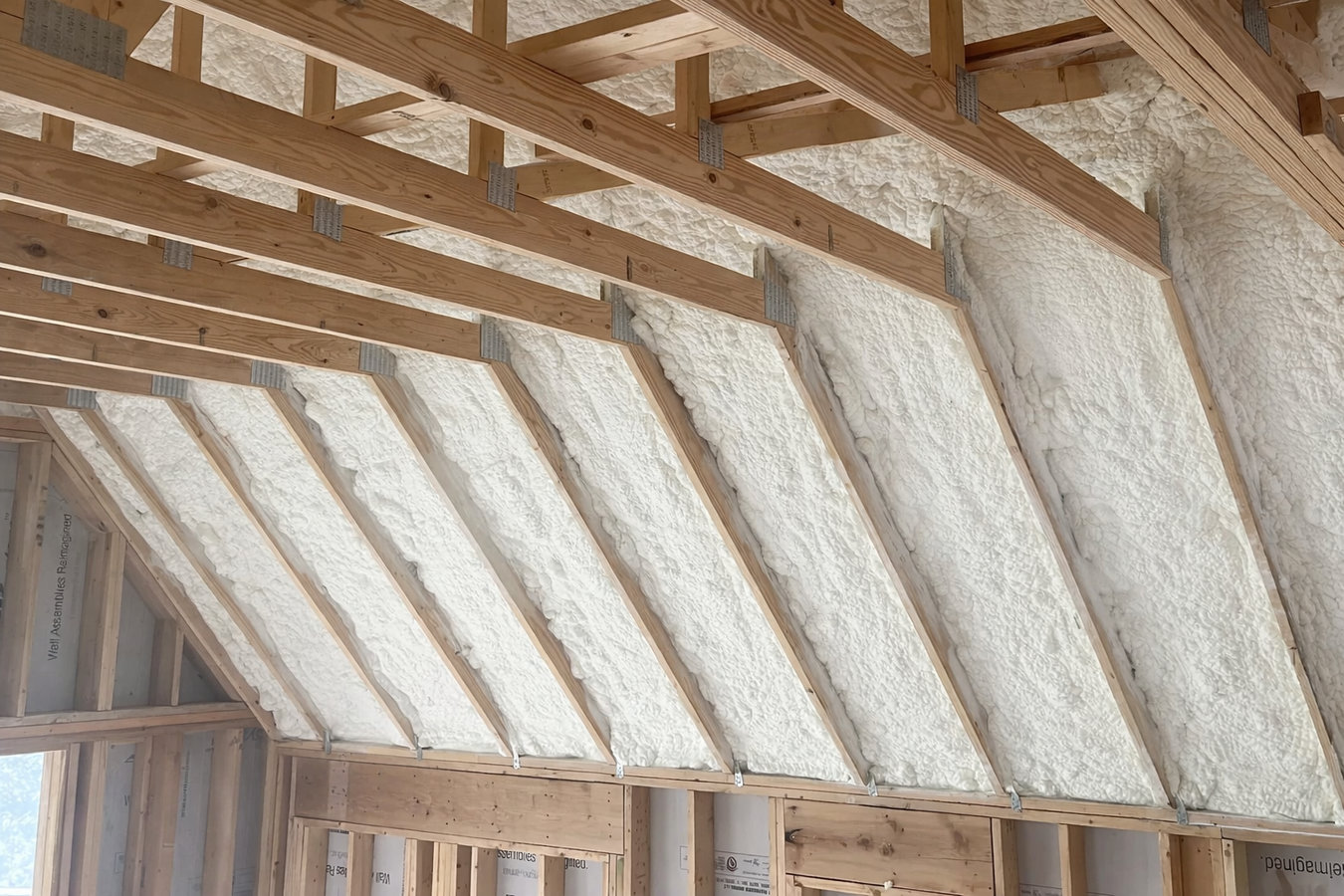
Cold drafts, high bills, and musty crawl spaces are signs your home lacks a real air and moisture barrier. Closed-cell foam seals every gap permanently and keeps performing for the life of your home.
Closed-cell foam insulation in Jefferson City is a two-part spray that expands into a firm, dense layer on contact - most crawl space and attic jobs are completed in a single day, with a 24-hour wait before re-entry. Unlike fiberglass batts that only slow heat transfer, closed-cell foam seals air gaps and resists moisture at the same time, making it the strongest combined air and moisture barrier available for residential use. Jefferson City Insulation applies closed-cell foam in crawl spaces, basements, rim joists, and attics throughout central Missouri.
Many Jefferson City homeowners discover that their biggest energy problem is not insulation thickness - it is air leaks they cannot see. Most heat loss in older homes happens through gaps around pipes, wiring, and framing, not through the walls themselves. Closed-cell foam fills those gaps on contact and hardens into a permanent barrier. If your home also has uninsulated or poorly sealed attic spaces, pairing closed-cell foam work with our open-cell foam insulation service in lower-priority areas can deliver a complete solution at a lower overall cost.
The U.S. Department of Energy estimates that air sealing and insulation together can reduce heating and cooling costs by up to 15 percent in a typical home. In Jefferson City, where winters run cold from November through March and humid summers put pressure on crawl spaces and basements, that performance advantage is meaningful in both directions.
These signs are common in older Jefferson City homes and in any home with a crawl space or unfinished basement.
Jefferson City winters are genuinely cold, and if your furnace runs constantly but your home still feels drafty or uneven in temperature, conditioned air is escaping somewhere. Rooms above a crawl space or at the ends of the house that run consistently colder than the rest almost always point to missing or failing insulation.
In Jefferson City summers, an uninsulated crawl space becomes a breeding ground for mold and mildew on wood framing. If you notice a musty smell in first-floor rooms - especially after a stretch of humid weather - it is worth having someone look at the crawl space. That odor means moisture is accumulating on unprotected wood framing.
Older Jefferson City neighborhoods near the historic downtown and areas developed in the 1950s and 1960s were built to standards that are considered inadequate today. If your crawl space, rim joists, or attic have never been insulated, there is a reasonable chance closed-cell foam would be the first real air barrier your home has ever had.
If you have ever had a pipe freeze during a Jefferson City cold snap, that is a direct sign that the spaces around those pipes lack adequate insulation. Closed-cell foam applied to rim joists and crawl space walls creates a thermal buffer that keeps those areas above freezing even on the coldest nights. One frozen pipe is a warning; insulating prevents the next one.
We apply closed-cell foam wherever an air and moisture barrier matters most - crawl spaces, basement rim joists, exterior walls, and attics with complex framing. The right thickness depends on where the foam is going: in a Missouri climate, contractors typically target two to four inches in walls and three to five inches in attics or crawl spaces. We assess your home before recommending a thickness, and we explain our reasoning before any work begins. For homeowners who need the broader spray foam picture - including lower-density foam for interior walls and sound control - we offer our open-cell foam insulation service, which pairs naturally with closed-cell work in a whole-home insulation plan.
Beyond spray foam, we integrate closed-cell applications with our full spray foam insulation service when homeowners want to address multiple areas of the home at once. This is common in older Jefferson City homes where crawl spaces, attics, and rim joists all need attention in the same project. A combined approach reduces mobilization costs and gives the home a continuous, well-sealed thermal envelope in a single visit.
Applies to crawl space walls and floor joists to stop moisture condensation and create a fully sealed, conditioned space.
Fills and seals the perimeter framing where the floor meets the foundation - one of the highest-impact applications in older homes.
Applied along the roof deck or attic floor to stop heat transfer and reduce attic temperatures that press into living spaces below.
Seals and insulates interior foundation walls, addressing both heat loss and moisture intrusion in Jefferson City basements.
Assessment and phased foam application across multiple areas for homeowners addressing the full building envelope.
Targeted closed-cell foam around rim joists and exposed pipe runs to prevent freezing during Jefferson City cold snaps.
Jefferson City sits in a climate zone with average January lows in the mid-20s Fahrenheit and summer highs regularly climbing into the 90s with high humidity. That combination means your insulation has to perform in both directions year-round - keeping heat in from November through March and keeping moisture out from June through August. Closed-cell foam handles both demands well, which is why it is a popular choice in mid-Missouri rather than milder climates where the payoff is smaller. A significant portion of Jefferson City homes - particularly those near the Capitol and in neighborhoods developed in the 1950s and 1960s - were built before modern insulation standards, and many crawl spaces and rim joists in those areas have never had a proper air barrier installed.
Missouri summers bring high relative humidity, and Jefferson City homes near the Missouri River corridor can experience this more intensely in low-lying areas. Unconditioned crawl spaces in this environment are prone to condensation on wood framing, which over time leads to mold and structural wood rot. Homeowners in Columbia and Fulton face the same seasonal conditions, and our team serves the entire central Missouri region with the same approach we apply here in Jefferson City.
We ask a few basic questions - which area you are concerned about, any problems you have noticed, and roughly how old the house is. We respond within 1 business day and schedule an in-person estimate at your convenience.
A contractor walks through the relevant areas of your home - crawl space, attic, basement, or walls - takes measurements, checks for moisture issues and access challenges, and explains the recommendation in plain terms. You receive a written estimate before anyone asks you to commit.
The crew arrives with spray equipment and applies foam in controlled passes - the material expands and hardens within seconds. Most residential jobs are completed in a single day. Plan to be out of the home and treated space for at least 24 hours after application.
After the ventilation period, we walk you through the finished foam - showing coverage, pointing out areas that required extra attention, and answering any questions. You should see even, consistent foam across every surface that was treated before we leave.
Free written estimate. We walk through your crawl space or attic with you, explain what we find, and quote the job in writing before any work is agreed to.
(573) 257-2944We measure the space and explain the recommended foam thickness before any work begins. In a Jefferson City climate, the right thickness in crawl spaces and attics makes a real difference in performance. You will know what you are getting and why - not just a number on an invoice.
We handle Jefferson City permit applications when the scope of work requires one, and coordinate the inspection with the city. Our experienced crews document the work from start to finish, so you have a clear record of what was installed.
We have worked in older neighborhoods near the Capitol, ranch homes on the west side, and newer subdivisions across central Missouri. Jefferson City homes present specific challenges - aging foundations, clay-heavy soil moisture, and framing gaps from decades of settling - and we know what to look for in every space we enter.
Before leaving, we show you the finished foam and explain what was done and why. The Spray Polyurethane Foam Alliance sets professional standards for foam contractors, and our process reflects those standards - you see the finished work and get your questions answered before we pack up.
When you invest in closed-cell foam, you are making a permanent decision about how your home performs. We take that seriously on every job, whether it is a single crawl space or a full building envelope project.
Learn more about spray foam safety from the U.S. EPA Spray Polyurethane Foam resource. Industry installation standards are maintained by the Spray Polyurethane Foam Alliance (SPFA).
A lighter, more affordable foam option suited for interior walls and attic floors where moisture resistance is a lower priority.
Learn moreOur full spray foam service covers both open- and closed-cell applications across all areas of the home in a single project.
Learn moreClosed-cell foam is a one-time installation that keeps working for decades - the sooner it goes in, the sooner you stop paying for the air leaks and moisture problems you have now. Call us or request a free estimate today.